Showing posts with label Trading Forex. Show all posts

What is Leverage? by Jeremy Wagner, Head Forex Trading Instructor

What is Leverage? by Jeremy Wagner, Head Forex Trading Instructor
What is Leverage? by Jeremy Wagner, Head Forex Trading Instructor (freeforexexpertadvisor.com)

Leverage is a financial tool that allows an individual to increase their market exposure to a point that exceeds their actual investment. For example, a trader goes long 10000 units of the USD/JPY, with $1,000 dollars of equity in their account.

The USD/JPY trade is equivalent to controlling $10,000. Because the trade is 10 times larger than the equity in the trader’s account, the account is said to be leveraged 10 times or 10:1.

What is Leverage? by Jeremy Wagner, Head Forex Trading Instructor

Had the trader bought 20,000 units of the USD/JPY, which is equivalent to $20,000, their account would have been leveraged 20:1.

What is Leverage? by Jeremy Wagner, Head Forex Trading Instructor

Leverage allows an individual to control larger trade sizes. Traders will use this tool as a way to magnify their returns. It’s imperative to stress, that losses are also magnified when leverage is used. Therefore, it is important to understand that leverage needs to be controlled.

FXCM provides flexible leverage to its clients. You can trade with no leverage at all, or you can trade with a significant amount of leverage.

FXCM believes clients have a greater chance of long-term success when a conservative amount of leverage, or even no leverage, is implemented.

Written by Jeremy Wagner, Lead Trading Instructor, DailyFX.com Education
Read more ...

The Long and Short of it, by James Stanley, Forex Trading Instructor

The Long and Short of it, by James Stanley, Forex Trading Instructor
The Long and Short of it (Photo by, coastalcarenet.org)

Aspiring traders will often be familiar with the concept of buying to initiate a trade. After all, since many of us are children we are taught the basic premise of ‘buying low, and selling high.’

In financial markets, jargon often plays a key role. Jargon helps show familiarity and comfort with a particular subject matter, and nowhere is this jargon more apparent than when discussing the ‘position,’ of a trade.

When a trader is buying with the prospect of closing the trade at a higher price later, the trader is said to be going ‘Long,’ in the trade. The following graphic will illustrate the dynamic of a long position:


While this premise may seem easy enough, the next may be slightly more unconventional to new traders.

The concept of selling something that isn’t already owned may prove as a confusing concept, but in their ever-evolving pragmatism traders created a mannerism for doing so.

When a trader is going ‘Short,’ in a trade, they are selling with the goal of buying back (to cover the trade) at a lower price. The difference between the initial selling price, and the price at which the trade was ‘covered,’ is the traders profit to keep less any fees, commissions, or selling expenses. The chart below illustrates a ‘Short,’ position.


It’s important to note the interesting distinction between currencies and other markets. Because currencies are quoted with two sides (each quote references 2 different currencies taking opposing positions), each trade offers the trader long and short exposure in varying currencies.

For example, a trader going short EUR/AUD would be selling Euro’s and going long Australian Dollars. If, however, the trader went long the currency pair – they would be buying Euro’s and selling Australian Dollars.

Written by James B. Stanley

To contact James Stanley, please email Instructor@DailyFX.Com. You can follow James on Twitter @JStanleyFX
Read more ...

Currency Names and Symbols, by Richard Krivo, Trading Instructor

Currency Names and Symbols, by Richard Krivo, Trading Instructor
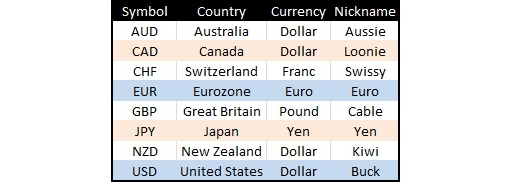
As you may have noticed, the symbols (abbreviations) for all currencies have three letters. The first two letters denote the name of the country and third letter stands for the name of that country’s currency.

As an example, let’s look at the USD. The US stands for United States and the D stands Dollar.

The currencies on which the majority of traders focus are called the “majors”. The most widely traded currencies are represented on the grid below:


Not to be confused with major currencies are the major currency pairs. The Major Pairs are any currency pair with USD in them. For example, the EURUSD would be considered a Major Pair.


Currency pairs without the USD in them are referred to as Cross Pairs. The EURJPY would be an example of a Cross Pair.


To carry this one step further, any EUR pair without the USD in it would be referred to as a Euro Cross. So the EURJPY would be a member of the EURO Cross group. Other member of that group would be EURGBP, EURCHF, EURNZD, EURCAD and EURAUD.

Other currency groups of this type would be comprised of the JPY crosses, GBP crosses, AUD crosses, NZD crosses and the CHF crosses.

by Richard Krivo, Trading Instructor / dailyfx.com
Read more ...

The Basics of How Money is Made Trading Forex

The Basics of How Money is Made Trading Forex
The Basics of How Money is Made Trading Forex (gorillaconvict.com)

Trading currency in the Forex market centers around the basic concepts of buying and selling.

Let's take the idea of buying first. What if you bought something (it could literally be almost anything...a house, a piece of jewelry or a stock) and it went up in value. If you sold it at that point, you would have made a profit...the difference between what you paid originally and the greater value that the item is worth now.

Currency trading is the same way...

Let's say you want to buy the AUDUSD currency pair. If the AUD goes up in value relative to the USD and then you sell it, you will have made a profit. A trader in this example would be buying the AUD and selling the USD at the same time.

For example if the AUDUSD pair was bought at 1.0615 and the pair moved up to 1.0700 at the time that the trade was closed/exited, the profit on the trade would have been 85 pips. (See the chart below…)


 Had the pair moved down to 1.0600 before the trade was closed, the loss on the trade would have been 40 pips.

Also, it makes no difference which currency pair you are trading. If the price of the currency you are buying goes up from the time you bought it, you will have made a profit.

Here is another example using the AUD. In this case we still want to buy the AUD but let’s do this with the EURAUD currency pair. In this instance we would sell the pair. We would be selling the EUR and buying the AUD simultaneously. Should the AUD go up relative to the EUR we would profit as we bought the AUD.

In this example if we sold the EURAUD pair at 1.2320 and the price moved down to 1.2250 when we closed the position, we would have made a profit of 70 pips. Had the pair moved up instead and we closed out the position at 1.2360 we would have had a loss of 40 pips on the trade.

Remember, we are always buying or selling the currency on the left side of the pair. If we buy the currency on the left side, which is called the base currency, we are selling the one on the right side which is called the cross or counter currency. The opposite would be true if we were selling the currency on the left side.

Now let's take a look at how a trader can make a profit by selling a currency pair. This concept is a little trickier to understand than buying. It is based on the idea of selling something that you borrowed as opposed to selling something that you own.

In the case of currency trading, when taking a sell position you would borrow the currency in the pair that you were selling from your broker (this all takes place seamlessly within the trading station when the trade is executed) and if the price went down, you would then sell it back to the broker at the lower price. The difference between the price at which you borrowed it (the higher price) and the price at which you sold it back to them (the lower price) would be your profit.

For example, let’s say a trader believes that the USD will go down relative to the JPY. In this case the trader would want to sell the USDJPY pair. They would be selling the USD and buying the JPY at the same time. The trader would be borrowing the USD from their broker when they execute the trade. If the trade moved in their favor the JPY would increase in value and the USD would decrease. At the point where they closed out the trade, their profits from the JPY increasing in value would be used to pay back the broker for the borrowed USD at the now lower price. After paying back the broker, the remainder would be their profit on the trade.

For example, let’s say the trader shorted the USDJPY pair at 76.28. If the pair did in fact move down and the trader closed/exited the position at 75.81, the profit on the trade would be 47 pips.


On the other hand, if the pair was shorted at 76.28 and the pair did not move down but rather it moved up to 76.50 when the position was closed, there would be a loss on the trade of 22 pips.

In a nutshell, this how you can make a profit from selling something that you do not own.

In wrapping up, if you buy a currency pair and it moves up, that trade would show a profit. If you sell a currency pair and it moves down, that trade would show a profit.

by Jeremy Wagner, Head Forex Trading Instructor, dailyfx.com

Read more ...